
Defending Democracy: Countering Information Manipulation in Eastern and Southeastern Europe
Side Event of the Munich Security Conference
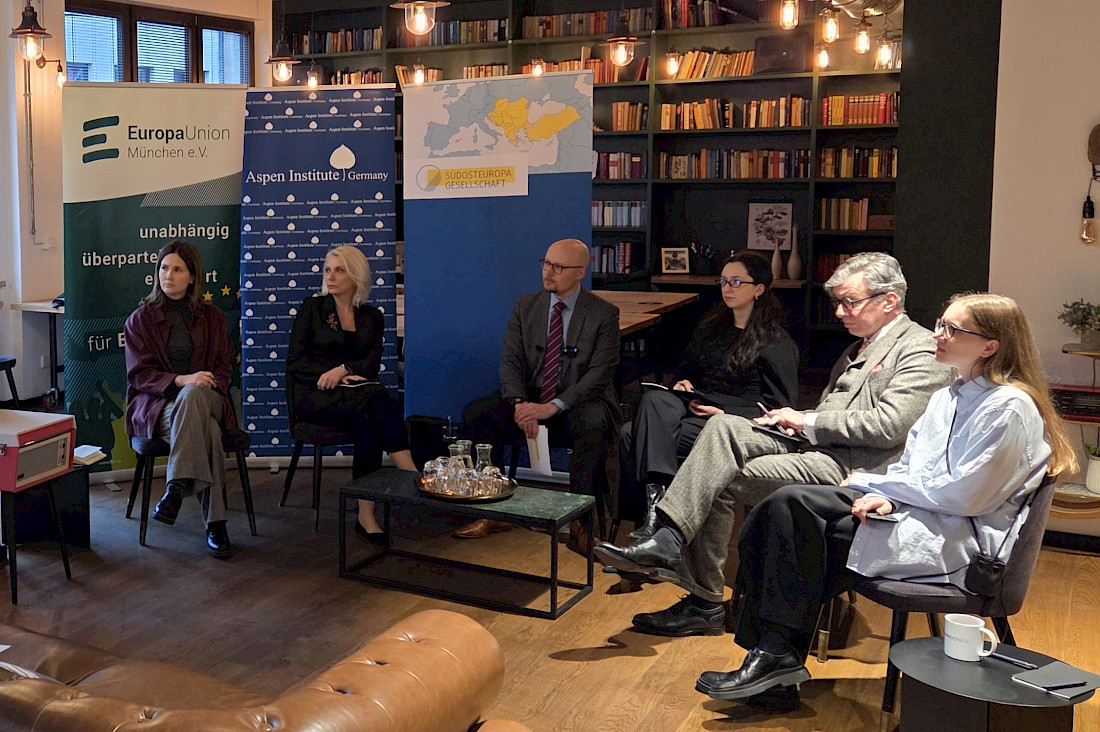
Speakers
- Sunčica Bakić, Director of the Agency for Electronic Media, Montenegro
- Johana Bázlerová, Social Media Influencer, Czechia
- Anastasiia Mozghova, Social Media Influencer, Ukraine
- Milijana Rogač, Editor-in-chief, Istinomer, Serbia
Moderation
- Christian Hagemann, Executive Director of the Southeast Europe Association e.V.
About
Information manipulation has emerged as a central instrument of hybrid warfare, threatening democratic institutions and exacerbating social and political polarization. In recent years, both foreign and domestic actors have intensified campaigns spreading false or misleading narratives to advance anti-democratic and divisive agendas. Countries in Eastern and Southeast Europe are particularly vulnerable as a result of their strategic position at the eastern and southern edges of NATO and the EU, making this a major security concern for the broader region.
These campaigns target both EU member states, such as the Czech Republic and Romania, which experienced waves of information manipulation ahead of recent elections, as well as countries in the EU enlargement region. Serbia, for instance, serves as a hub for information manipulation in the Western Balkans, while Ukraine has seen a massive increase in information manipulation since the beginning of Russia’s war of aggression.
This dynamic creates a dual security threat. In EU enlargement countries, information manipulation erodes support for EU integration and democratic reforms, opening space for authoritarian forces and malign foreign actors to present themselves as viable alternatives and extend their influence. In eastern and southeastern EU member states, information manipulation not only threatens democratic institutions but also undermines public support for sensitive foreign policy decisions, weakening the Union’s ability to act cohesively.
The discussion will bring together social media influencers, content creators, civil society experts, and government representatives to examine strategies, challenges, and practical tools for countering weaponized disinformation. The Panelists will explore how collaboration between influencers, civil society, and EU institutions can strengthen societal resilience, promote transparent communication, and build secure information environments ahead of future EU enlargement. The session will focus on actionable solutions, highlighting the crucial role digital actors play in safeguarding information integrity.
+++ We have reached the capacity limits and can no longer accept registrations. Thank you for understanding. +++
Am 14.02.2026, 16:00 Uhr
Ort: Mindspace, Viktualienmarkt, Rosental 7, München
In cooperation with: